ISSUE 09: The invisible product problem
Welcome to The Red Thread, a weekly(-ish) branding and culture newsletter exploring what founder-led brands can learn from cult luxury heavyweights in order to build the same kind of timeless, relevant, culturally aware, and irreplaceable positioning in their own categories.
If you find this useful and would like The Red Thread directly to your inbox, then subscribe for free below
I came across Lore at the end of 2025, and I haven’t been able to shut up about it.
I found it the way most people find things these days: a late night doomscroll when I should’ve been sleeping, but instead falling bleary-eyed into random corners of the internet. An hour later, I had devoured every single Instagram post, every single bit of editorial, and was fan-girling hard on Melanie Bender.
And in that wee hour of the morning, I had a realisation. I near enough shouted it out loud –THIS IS IT. This is the thing so many service-based founders are trying to crack but don’t know how to name.
Lore is a fragrance brand founded by Melanie Bender (ex Rhode, Versed, Merit), designed in LA and launched in 2025. It has four scents, all petrochemical-free, refillable, and priced at $92 for 50ml. I guess on paper it’s not really a radical proposition. The indie fragrance space is already crowded, the sustainability path is well-walked, and the DTC-first model is hardly novel.
And yet the brand has already built something that many brands spend many years (and many monies) trying to manufacture and never quite get there. They’ve built a world. A genuine, coherent, emotionally specific world that pulls you in before you’ve parted with a penny. Before you’ve even caught a whiff.
Lore is not simply describing their products. They’re not listing notes or talking you through the olfactory pyramid. They’re creating scents inspired by emotional states – Somewhere but Nowhere, Disfruta, Lovely and a Little Twisted, Sublimity – and letting the feeling do the work that the feature can’t.
The invisible product problem
I want to give a name to the challenge I suspect you’re facing if you’re the founder of a service-based business – coaching, consulting, anything where the value lives inside the transformation rather than on a shelf.
Let’s talk about the invisible product problem.
A bit like a scent, you are selling something that cannot be seen, photographed, screenshotted, or shared. There is no unboxing moment. There is no visible status signal that tells the world your client bought from you, or what insider knowledge they now have that others don’t. What you’re selling is a feeling. A change. An outcome that happens entirely inside another person.
And most service founders, when confronted with this problem, do one of two things. They either over-explain the process (here’s my six-step framework, here’s my methodology, here’s my certification!), which mistakes proof of process for proof of transformation. Or they lean entirely on social proof (here are my testimonials, here are my case studies, here’s what my clients say!), which is useful, but borrowed. It’s just somebody else’s experience of the thing, not the thing itself.
Neither the process nor the social proof fully answers the question the potential client is actually asking, which is not ‘how does this work?’ It’s ‘how will I feel?’
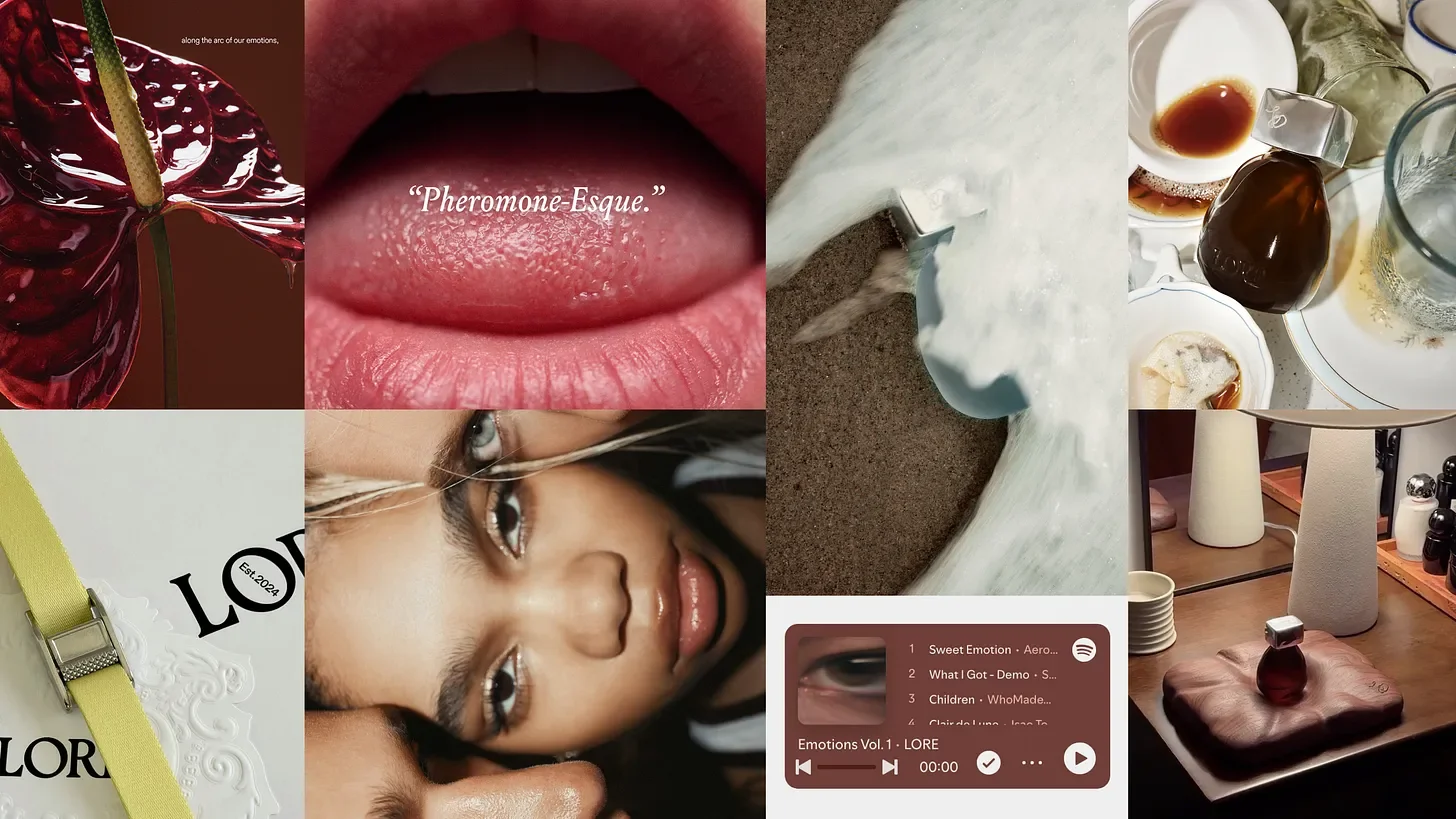
Via: Lore
This is where the Lore lesson becomes instructive. They’ve very quickly figured out that when the product is invisible, the world around it has to work that much harder to do the selling.
Look at what Melanie has built in Lore’s Explore section, which is the part of the website that has no commercial function whatsoever. There are no product listings, no add-to-cart buttons, and it’s somehow the most persuasive part of the entire thing.
There’s a long-form interview with the bottle’s designer, Jérôme Laurendeau, about 40 to 50 form versions and 150 colour variations, two trips to Lima to perfect the glass mould, and a moment where Melanie wanted the machines to be turned upside down (they clearly couldn’t be turned upside down). There’s a biodiversity framework developed with conservation ecologists, including a year-long ingredient audit that identified endangered species in the fragrance supply chain. There’s an editorial series called Emotions Vol. 1, a periodical of image and sound, not product content, that exists purely to make you feel something.
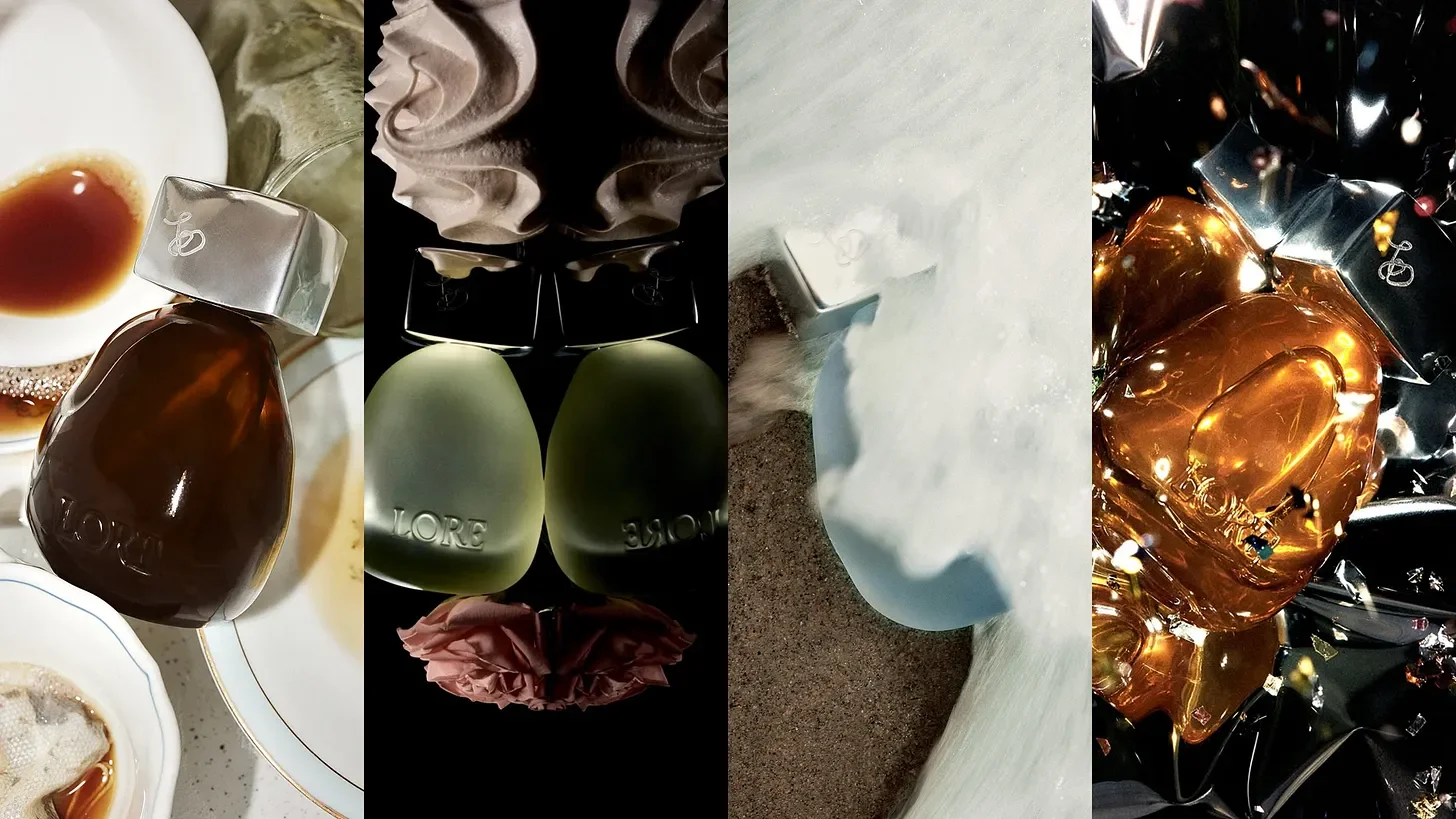
Via: Lore
And it’s not just the editorial content putting in the paces, they’ve designed each product page as its own universe. A different colour palette, different imagery, a dedicated campaign film for each scent. You don’t land on a generic product grid, you land inside the world of that specific fragrance. The overarching Lore visual identity isn’t copy/paste applied across the product range, but instead, each has one built specifically around the scent’s emotional identity.
The bottle itself is designed for display rather than the bathroom cabinet. The cap, already beautiful enough to sit on a shelf, is intentionally designed to be used as a candle holder. With Lore, the thing you throw away in every other brand is an object worth keeping.
Nothing is neutral. All of it tells you exactly what kind of world this is, and by the time you’ve spent twenty minutes in it, you understand what it would feel like to belong to it.
Build the world
And that’s the question your service brand needs to answer before anyone will think to sign a contract.
The question of ‘what will I get?’, clients can read that on your services page. Or ‘has it worked for others?’, that’s what testimonials are for. The question underneath both of those is: ‘what will it actually feel like to be in this?’ To be in your process, your emails, your sessions, your way of thinking? Is it rigorous or warm? Challenging or reassuring? Fast-moving or considered?
Lore answers this by building an emotional world. None of it spells out what the fragrance smells like, yet all of it tells you what it feels like to be someone who wears it.
Your equivalent isn’t a candle holder or a bottle, but it does exist. Your equivalent is the way you write, the things you choose to talk about publicly, the clients you take on and the ones you don’t. It’s the experience of how you show up in your content, your onboarding, your proposals. The references you drop, what you read, what you cite, what cultural touchstones you bring into your thinking.
Every one of those things is what marketers call a touchpoint. Jazzy terminology, yes. But every one of them is either building a sense of what it means to work with you over others, or it isn’t.
So, here’s the translation for you if you’re building something service-based.
The question coaches and consultants need to answer before expecting anyone to hire you is: ‘how will I feel having worked with you?’ Most service founders, when asked this, will tell me about their framework, their niche, or their years of experience. Very few can tell me (without hesitating) what it actually feels like to be their client.
If every touchpoint is an opportunity to make people feel something, what are yours making them feel?
Until next week,
Hilary x