ISSUE 05: Burning of the velvet rope & the post-luxury mindset
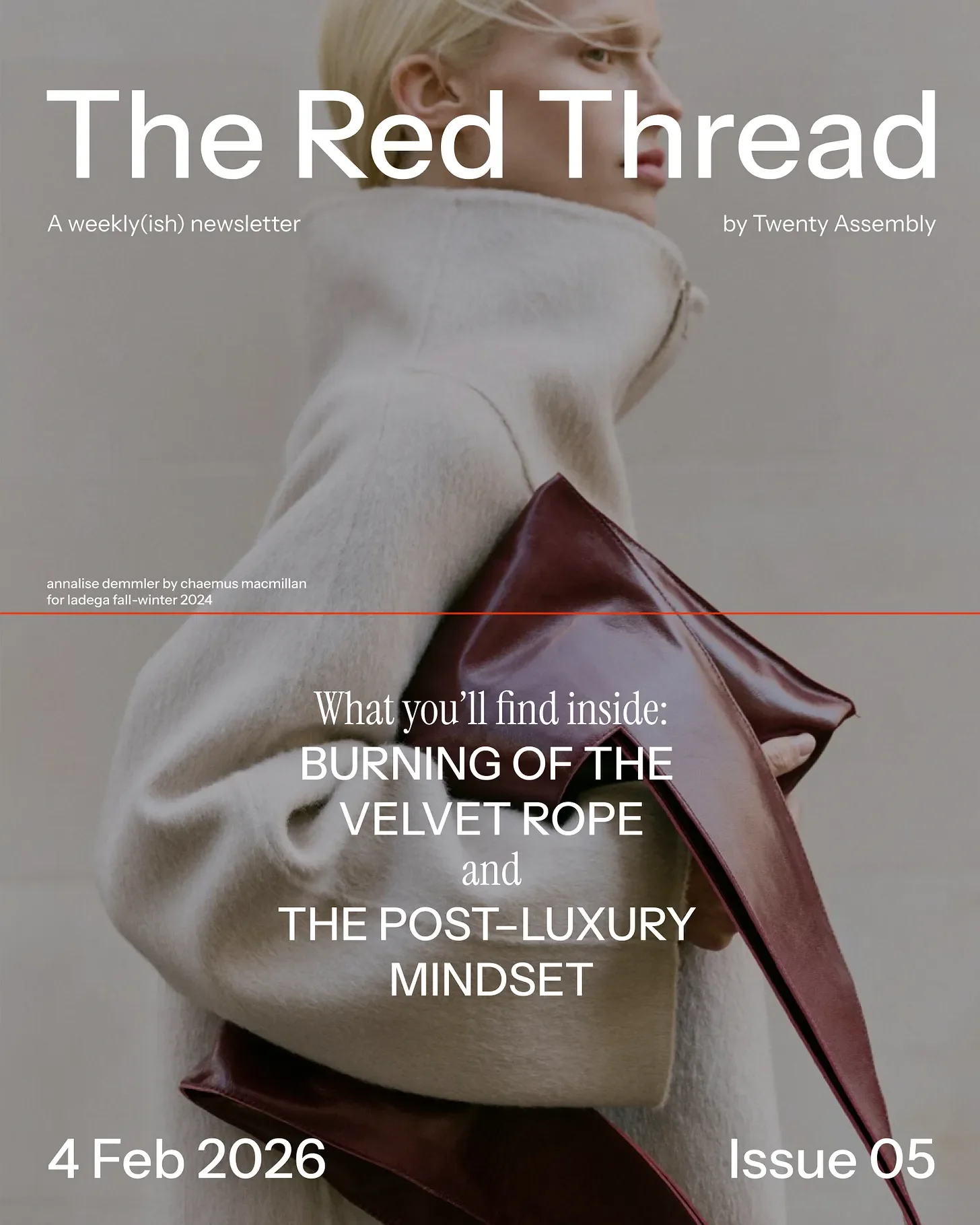
Welcome to The Red Thread, a weekly(-ish) branding and culture newsletter exploring what founder-led brands can learn from cult luxury heavyweights in order to build the same kind of timeless, relevant, culturally aware, and irreplaceable positioning in their own categories.
If you find this useful and would like The Red Thread directly to your inbox, then subscribe for free below
There’s a lot of talk bubbling up in my corner of the internetosphere about how we’ve entered a ‘post-luxury era’.
I’ve read some great pieces on it in the last couple of days. Camille Moore started noticing signs of it on a flight to LA, and Eugene Healey is giving us a six-part deep dive in post-luxury status symbols (accompanied by a reading list and discussion questions for my inner nerd!). Everywhere you turn there are warnings of shifting sands, and the luxury industry is doing some serious rethinking to get ahead of it.
Yep, it’s clear we are firmly in the post-luxury era, but not in the way the term was first used almost a decade ago. So what does it mean in layman’s terms, why does it matter, and most importantly, what should founders (in any category) understand?
Here’s my take.
The burning of the velvet rope
Don’t get me wrong, this is not the end of high-end consumption. People are still buying eye-wateringly expensive things. What has ended is the automatic link between luxury, logos, and price tags.
In 2026, luxury has decoupled from visibility. We’ve moved from an era of acquisition: buying to signal wealth, to one of actualisation: buying to signal values, knowledge, taste, and discernment. The new status marker isn’t what you bought, but why you chose it.
The old luxury equation was simple:
Scarcity + High Price + Heritage = Status
The post-luxury equation looks very different:
Transparency + Values + Hyper-Personalisation = Relevance
The post-luxury consumer practices what I’d call assertive under-consumption. They can afford the logo, they just don’t want it. They’ll pair a £7,000 Khaite coat with a £10 vintage tee that tells a far better story than head-to-toe logos ever did.
Status has shifted from haves to knows. Wearing something unrecognisable to most, but immediately legible to a specific few, is now the ultimate flex. The “upgrade ladder” has collapsed. As incomes rise, people don’t automatically trade up anymore. They stay loyal to brands that earn their trust, and only spend when there’s genuine craft, meaning, or long-term value.
Often, the product itself is no longer the luxury. It’s the access, the experience, or the philosophy behind it. The object is just the souvenir.
Here’s the shift summarised:
Status moved from conspicuous to coded
Value moved from price to provenance
Access moved from velvet ropes to shared knowledge
Loyalty moved from points to participation
It’s a bit of a minefield. But luckily, this isn’t abstract, you can see it clearly in how the strongest luxury brands are behaving now.
Here’s how founder-led brands can adapt the same mindset in order to succeed, not just survive the shift.
The post-luxury mindset
1. From Logos to Codes
Some of the most powerful brands today are intentionally quiet. Recognition is reserved for the right people, not the biggest audience.
You see this in brands like The Row. Controversies aside, they were quiet luxury coded before quiet luxury even had a name. They embody status that is communicated through fabric, cut, and restraint rather than logos. The brand has mastered the art of silent marketing. No explanations, nor performance. Just product integrity and insider understanding.
Founder-led brands can do the same by ditching shouty signals for building visual or verbal recognisable codes that an audience learns over time. This might look like a functional beverage brand that removes colour names, flavours, or SKUs altogether. Everything is numbered, dated, or batched. The code becomes literacy: you either know what “No. 03” means or you don’t. Or a jewellery brand only showing cropped details instead of full products on social media, hyper-fixated on craftsmanship.
Codes are how luxury is read from the outside. Quiet markers, legible only to those paying attention.
2. From Product to Philosophy
Post-luxury brands aren’t just selling things. They’re broadcasting a worldview.
Loewe doesn’t simply sell leather goods. Through the Loewe Foundation Craft Prize, it became a curator of craft, art, and taste. They shifted the value proposition from ‘expensive leather’ to ‘intellectual curiosity’. The product is downstream of the worldview.
Founder-led brands can apply this without huge budgets simply by publishing taste, curation, and thinking. A skincare founder writing about what they don’t believe in, a design studio sharing references, books, and edits rather than case studies, or a consultant publishing decision frameworks instead of portfolios.
People buy into how you see the world before they buy what you sell.
3. From Price Justification to Moral Justification
High prices now require emotional and ethical clarity.
Brands like Brunello Cucinelli have mastered this by openly discussing wages, restoration projects, and refusing over-distribution. In a delicate time of widening wealth inequality, consumers are seeking some sort of moral alibi to feel clean about their consumption. “I am not just buying a £2,250 cashmere jumper; I am supporting Italian heritage and fair wages”.
Founder-led brands can aid this by demonstrating their own moral backbone. Being radically clear about how the money moves through your business, publishing what you refuse to optimise for, or highlighting the people behind the work, with real numbers and real names.
4. From Objects to Assets
Post-luxury consumers think about exit value before entry price. Resale is not a competitor anymore, it is a validation of a brand's worth. If a product has no resale value, it is disposable, not luxury.
In response, brands have leaned into tech passports, repairability, and resale, treating products as assets, not disposables.
Tod’s introduced NFC chips in their custom Di Bags. A quick scan reveals the bag’s entire journey, craftsmanship details, and an authenticity token. Pangaia has “Digital Passports” that allow you to scan a hoodie to see its carbon impact, circularity data, and, most crucially, facilitate instant resale.
Founder-led brands can mirror this thinking by supporting second lives: build your own private resale channels, offer lifetime repairs, transferable licences, or simply design damn good things that people won’t want to throw away.
5. From Velvet Ropes to Meaningful Access
Access no longer means VIP rooms, guest lists, and velvet ropes. The most valuable thing a brand can offer now is proximity to knowledge, taste, and decision-making. The product isn’t the destination, it’s the passport to internal belonging. If codes are what attracts the right people, meaningful access is what keeps them.
We’ve seen this access take many forms in luxury. A brand like Vacheron Constantin might not give customers a discount, but they will invite customers to understand process at the master watchmaker’s bench. It’s a private Discord where a Creative Director drops sketches at 2 AM, or where "Super-VIPs" discuss archival pieces with each other. Or it’s ideological access like Miu Miu’s invitation-only literary club.
In the post-luxury era, the product is not the point; it’s the credential. Brands are re-establishing a form of exclusivity. Ownership signals insider literacy, shared values, and belonging to a specific way of seeing. It’s no longer “I have this”, it’s “I know this”.
For founders building today, ask yourself: What can I teach my customers? How can I let them contribute to the brand's story? What "inner circle" can I create that feels earned, not extracted?
Community isn’t a marketing tactic anymore. It is the value.
Post-luxury doesn’t mean less luxury. It means quieter signals, higher standards, and deeper intent. Status has shifted from ownership to understanding.
For founders in any category, the lesson isn’t to chase scale or spectacle, but to build meaning, trust, and belonging. Today, the most valuable thing a brand can offer isn’t access to product, but access to a way of seeing.