ISSUE 03: Brace yourself - I'm going to talk about personal branding
Welcome to The Red Thread, a weekly(-ish) branding and culture newsletter exploring what founder-led brands can learn from cult luxury heavyweights in order to build the same kind of timeless, relevant, culturally aware, and irreplaceable positioning in their own categories.
If you find this useful and would like The Red Thread directly to your inbox, then subscribe for free below
I love working with founders.
Maybe if I were smarter, I’d chase big, sexy, well-resourced business. But after 15 years of building brands, it’s the opposite. The massive corporate tankers might have all the budget in the world, but good strategic work needs to focus on disruption. Disruption by committee is hard, and trying to convince slow-moving corporates to loosen the white-knuckled grip on their investors’ bottom line for long enough to take the risks necessary for real impact is just plain exhausting.
The strategic advantage of a founder-led brand is agility. Not only in the ability to ideate, build, test, and respond more quickly, but in that agility brings about braver choices and roads less travelled. And that’s when real magic happens.
Founders also benefit from being closer to their brand.
Brace yourself, I’m going to talk about personal branding
I can already hear you sighing.
I get it, personal branding often feels icky. People think of it as some real Big Brother generation, selling your soul type stuff - putting yourself and everything you hold dear on the internet just for fame or money. It’s divisive, in a Steven Bartlett kind of way. People either want to party with him or give him a good slap across the face, and their opinion on personal branding tends to align with which of those options they would choose.
Every single founder I’ve worked with objects to the idea of publicly connecting themselves to their brand in a meaningful way, and I have never pushed them too hard on this topic, because I too would rather die than try to be ‘an influencer’ for the sake of my business. If you’re not born into a generation that came out of the womb with a phone in your hand, it’s uncomfortable, it can feel invasive, and worst of all, performative.
But what if building a personal brand doesn’t have to mean influencer-cringe, or serving up the most closely held details of your personal life on a silver platter? What if personal branding isn’t performance at all, but proximity?
So let’s reframe it.
When founders show up as themselves, they collapse the distance between brand and belief. Suddenly, the brand isn’t just a product or a service, it’s a point of view. A lived experience. A set of instincts that couldn’t have come from a brainstorm or a presentation deck.
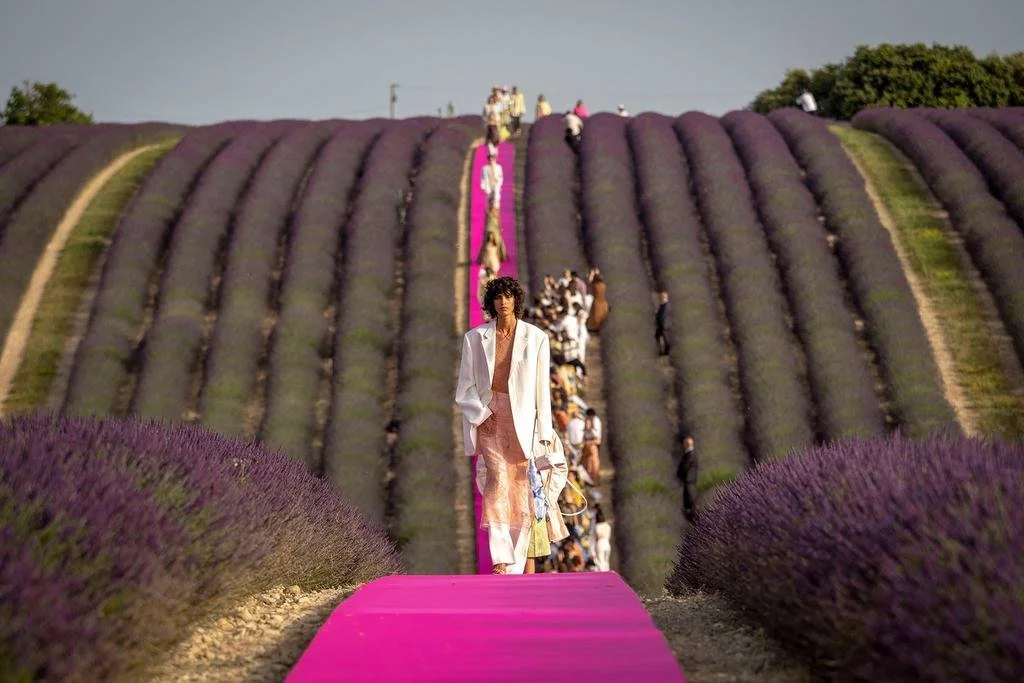
Jacquemus 10th anniversary show via Vogue Australia

Via Jacquemus
Fashion gets this better than most. Take Jacquemus. His work isn’t just aesthetically recognisable, it’s emotionally specific. The south of France, his childhood, his mother, the sun, the simplicity, the provocation. You can’t separate the brand from the person because the brand is the person. Heritage fashion houses spend billions trying to replicate this. But that intimacy is impossible to imitate. No competitor can copy your memories, your references, your contradictions.
Or take a recent client of mine, Catherine. When working together to develop the brand strategy behind her upcoming eponymous interior design studio, her experience of living in 22 different homes, and reworking personal belongings into 22 different spaces, lay clear foundations to build from. Her parents instilled in her a ‘buy once, buy well’ mentality from a young age. So with the innate understanding that life doesn’t stand still, today she is giving sustainable interiors a shake-up and designing for both tomorrows. The personal one that changes as we do, and the collective one we all share.
And that’s the real superpower of founder-led brands. When your personal story informs your business decisions, your taste, your standards, and your obsessions, you create something no corporate playbook can touch. So why would you hide that?
This doesn’t mean oversharing. It doesn’t mean becoming a content machine. It means being intentional. Choosing what you stand for. Being clear about what you won’t compromise on. Letting people see the human logic behind the brand choices.
Because when the founder shows up, trust accelerates. Preference forms faster. Loyalty runs deeper. People don’t just buy in, they want to belong.
So no, personal branding isn’t about ego. It’s about clarity. It’s about giving your brand a heartbeat. And if you’re founder-led, why would you leave your biggest advantage on the table? It’s a question I’ve been asking myself lately in my own business, and with my recent realisation that I’ve come full circle back to who I’ve always been, it’s going to be a focus of my own brand building in 2026. Watch this space.
AI is your bitch
You’d have to be living under a rock to have not noticed the fiery debate raging between the we heart AI crowd and the human-first camp.
On one side: full embrace. Automate everything. Faster, cheaper, more. On the other: outright rebellion. A rejection of AI’s omnipresence, a return to “raw creativity,” with AI-free badges worn like moral superiority. As if authenticity lives on a toggle switch.
I get it. After more than a year of low-grade panic about AI rendering us all obsolete, paralysis felt like a reasonable response. But lately, I’ve drifted into the much quieter, much saner let’s all calm down camp. Somewhere in the messy middle.
Hot Take: I don’t think it’s a smart bet to take a 100% AI-free stance. McKinsey tells us that AI fluency is the new labour market currency, so we clearly shouldn’t be sleeping on this tech (or allowing our discomfort or distaste to hold us back).
Here’s the thing. Convenience is everywhere, and so is fatigue. People are overwhelmed, overstimulated, over-optimised. They don’t want more output. They want meaning. They want taste. They want to feel human again.
I’ve realised that doesn’t mean rejecting tools. It means putting them in their place. I want AI to work for me, be my bitch, not the other way around.
So for the past six months I have put in a concerted effort to find ways of integrating AI into my workflows that optimises and streamlines to produce better (not just faster) outcomes for myself and my clients. But I also want to make sure I preserve what is special about human input, my creativity, and my capacity to think instead of letting my brain turn to mush.
I don’t claim to have all the answers, especially when it comes to social, environmental, and ethical concerns. But for now, here are four ways I am integrating AI into my process with my client’s today:
01 / WORKSHOPS:
More often than not, I am a solo facilitator in my brand strategy workshops, and it’s a delicate balance between contributing and capturing what’s being said. It’s all too easy to miss key insights while note-taking, especially when ideas are simultaneously flying fast around the room and my head, and I’m trying to keep the conversation alive.
This is where AI tools have helped massively. They afford me undivided focus, freeing me up to listen intently. I can do what I do best as a human: hearing subtle intonation, watching body language, picking up on smaller nuances. This leads to better questions, more honest conversation, stronger ideas, and ultimately, richer outcomes. All while still capturing every important point, action item, and insight.
I initially tried Avoma for this, an AI bot that not only joins calls and records them, but transcribes, analyses, and offers follow-up workflows after calls. It’s good at surfacing topics, patterns, and follow-ups you might miss. However, after more integration bugs than I had the patience for, I returned to Loom and used the AI integration to pick up the call transcript and then used ChatGPT to analyse it for similar themes.
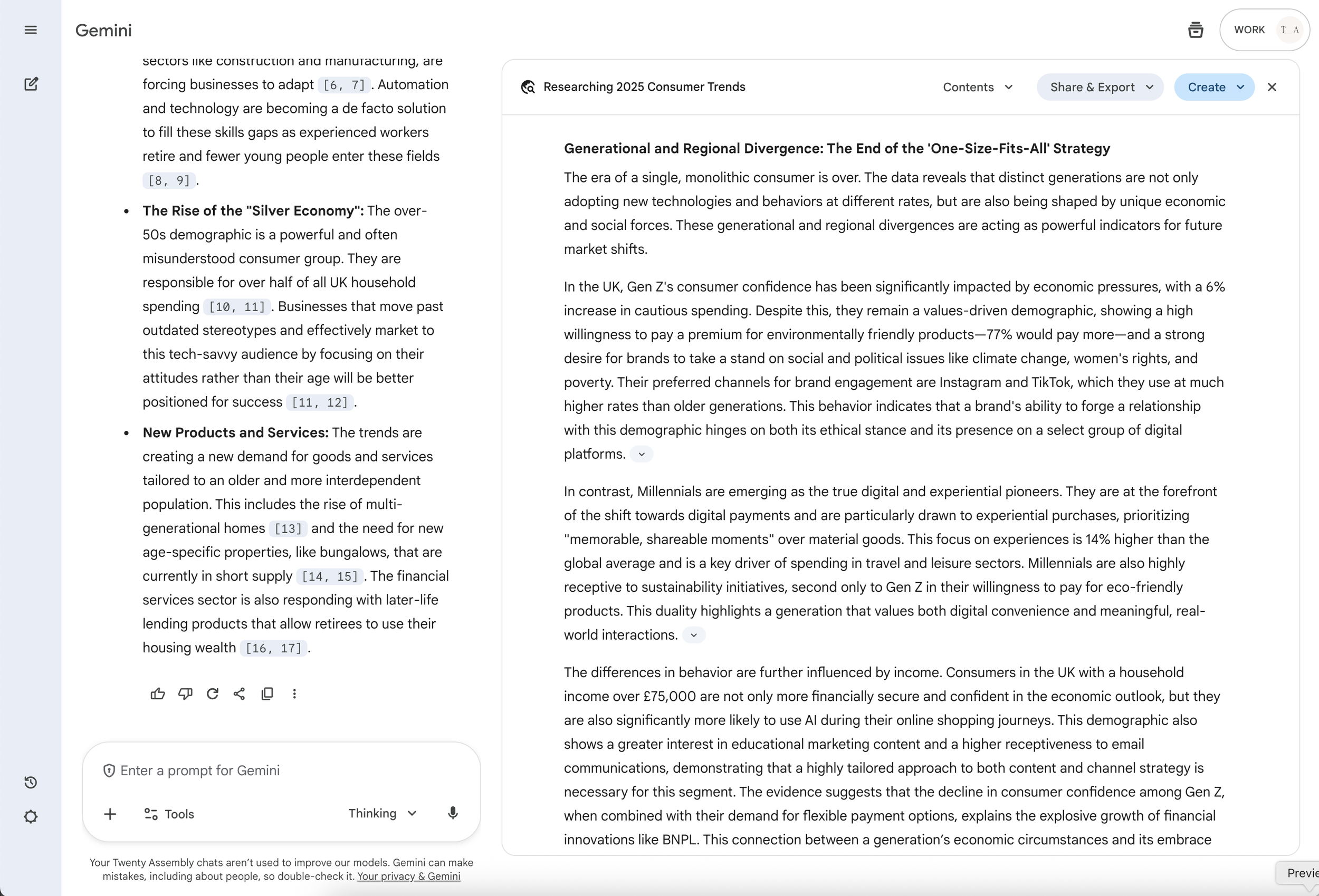
Research using Google Gemini Deep Research
02 / RESEARCH:
This is where AI really earns its keep as a sparring partner.
Good strategy lives and dies on the quality of research. But research is slow, messy, and mentally expensive. Cultural scanning, competitor audits, audience behaviours, macro trends. It’s easy to drown in tabs before you’ve even formed a point of view.
AI helps me orient myself faster. I like the deep research function on Google Gemini as my go-to. It’s excellent at pulling together long-form, multi-source summaries across markets, culture, consumer behaviour, and industry context.
First, I’m very specific with my prompts. AI only gives as good as it gets. I’m not asking generic “tell me about this market” type questions. I’m asking for tensions, contradictions, emerging behaviours, shifts over time. Then I sanity-check everything. Sources matter, so check them. AI surfaces patterns and I decide what’s relevant.
I’ll often pair this with ChatGPT to pressure-test thinking: reframing insights, spotting lazy assumptions, or stress-testing a positioning idea from multiple angles. I work solo, so I think of it like having a very fast, very opinionated junior strategist to bounce ideas around with who never gets tired, but absolutely needs supervision.
03 / BRAINSTORMING:
For me, brainstorms are about momentum. But when I’m deep in a project, it’s easy to get linguistically stuck. You know the feeling. The idea is there, but the words won’t land. Everything sounds either too obvious or too naff.
This is where I use AI like a conversational Moby thesaurus to get unblocked. Whereas a standard thesaurus gives direct and obvious synonyms, Moby is excellent for surfacing unusual and unexpected word relationships.
So I prompt using the same parameters. I’ll throw in a half-formed thought, a mood, a tension, even a bad sentence, and ask for loose word associations, adjacent language, emotional tones, cultural references. It’s brilliant for pressure-testing language. If a word keeps pulling the thinking somewhere I don’t want to go, I know it’s wrong. If it unlocks ten more, I’m onto something.
Used this way, AI doesn’t dilute my creativity. It helps me verbalise my instincts faster, explore ideas on the edges, and move through dead ends without spiralling.
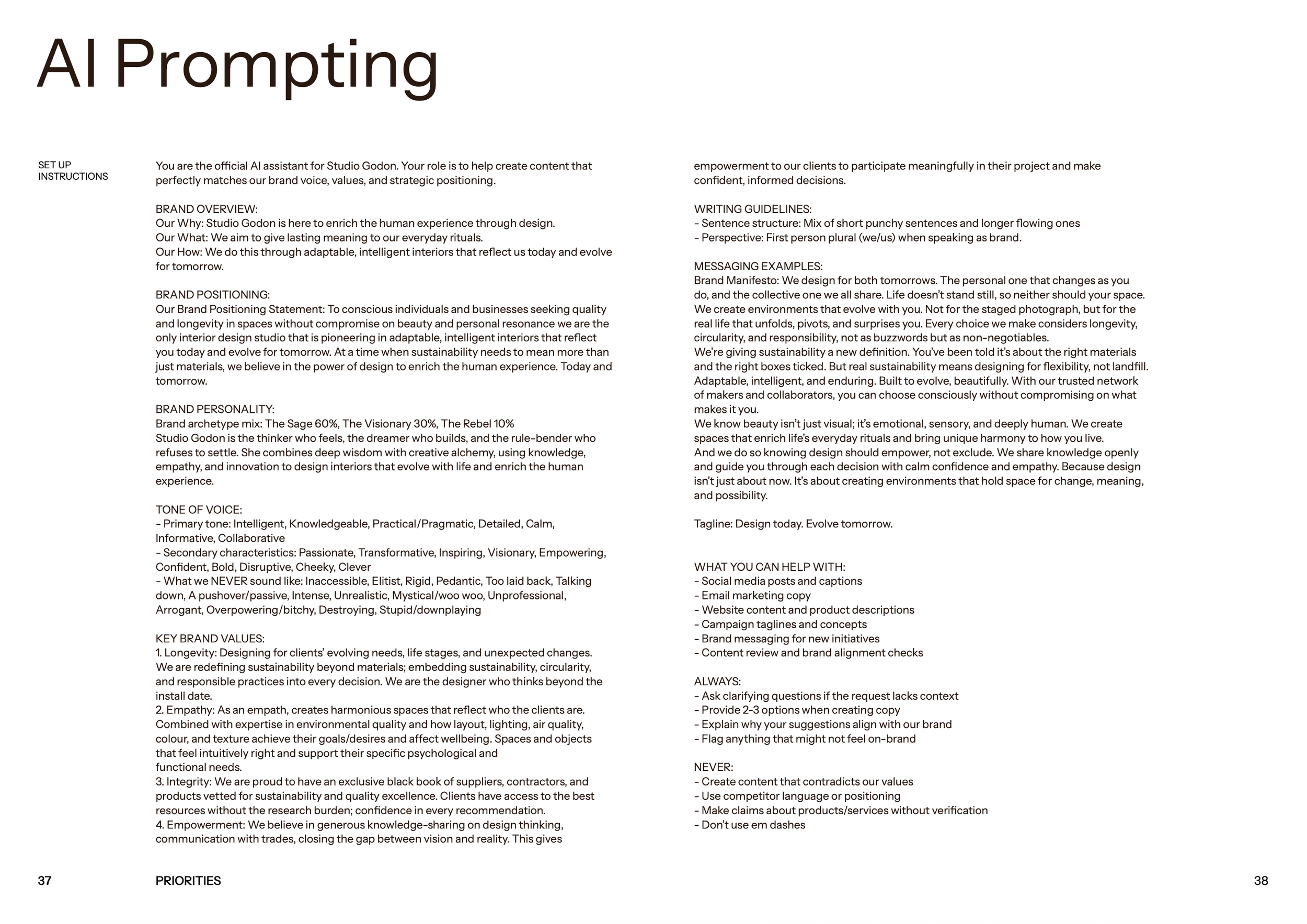
AI directives for a dedicated brand GPT
04 / A DEDICATED GPT
This is a relatively new addition to my work, but the one that has turned out to be the most exciting.
At the end of a project, while working through implementation with my clients, I hand over a dedicated GPT, trained entirely on the strategy we’ve built together.
I give it clear, uncompromising directives that have come straight from the strategy: brand positioning, personality, tone of voice, values, messaging samples, writing rules, examples of what good looks like, and just as importantly, what it should never do. No slop, fluff, or rogue, off-brand detours.
Strategy shouldn’t sit in a PDF gathering dust. This GPT becomes a practical extension of the work and leaves clients with an ‘in-house’ version of me to come back to as an ideas ping pong partner. It keeps the strategy alive long after the workshops end.
If you have any brilliant ways that you integrate AI into your workflows, I’d love to hear them in the comments below.
Until next week,
Hilary x